


One fence, every secure perimeter
Swipe through where galvanised palisade earns its keep.
Palisade run configurator
Pick your spec, watch the 3D model update, then choose how many sides your fence has and enter each length. We’ll work out every bay, post and fitting and add it to your basket. Drag the model to rotate.
Your order
The UK trade standard in security fencing
Palisade fencing is the go-to steel security fence for industrial and commercial perimeters — vertical pales bolted to horizontal rails on heavy steel posts, hot-dip galvanised to shrug off the British weather. Built to BS 1722 Part 12, it’s hard to climb, hard to cut, and specified everywhere from council depots and car parks to substations and schools. Buy a full 2.75m run to fence a new perimeter, or a single pale, post or rail for a repair or top-up.
D profile or W profile?
Same galvanised steel — the difference is thickness, security and cost. Select your choice in the options above.
W profile standard
2.0mm steel with a notched (W) top. Lighter and lower cost, ideal for domestic and lower-risk boundaries where budget matters more than maximum security.
- 2.0mm thick
- Lower cost per bay
- Domestic & light commercial
D profile triple-point
3.0mm steel with a triple-pointed top — heavier duty and much harder to climb or cut. The standard choice for commercial and high-security perimeters.
- 3.0mm thick
- Triple-point anti-climb top
- Commercial & high-security
Bolt-down or concrete-in?
How the posts fix to the ground. Both use the same pales and rails.
Bolt-down on hardstanding
Posts come with a welded 200×200×10mm baseplate and bolt straight to existing concrete or hardstanding with anchor bolts. Fastest to install, no digging.
- Fix to existing concrete
- No footings to dig
- Quick installation
Concrete-in set in ground
Plain-based posts set into a fresh concrete footing dug into the ground. More secure and the standard method for new installations on open ground.
- Set in fresh concrete
- Maximum stability
- Standard for new ground
Palisade heights: 1.8m to 3.0m
Taller = higher security. All five heights are galvanised and in stock.
| Height | Typical use | Security level |
|---|---|---|
| 1.8m | Domestic & light commercial boundaries | Low |
| 2.0m | Commercial boundaries & car parks | Low–medium |
| 2.1m | Commercial security perimeters | Medium |
| 2.4m | Depots, yards & higher-security sites (most popular) | High |
| 3.0m | Substations, utilities & infrastructure | Highest |
Galvanised or powder-coated colour
Every option is hot-dip galvanised first. Add a powder-coated colour for a cleaner look that blends into its surroundings.
Hot-dip galvanised steel, the industrial standard — best value and maximum corrosion protection.
Powder-coated over galvanising. Softens the look for schools, parks and professional settings.
A sharp, discreet finish for commercial frontages and car parks. Other RAL colours on request.
What’s in a 2.75m run — and every part on its own
Each 2.75m bay is a complete kit. Every component is also sold singly above for repairs, replacements and custom layouts.
17 pales (D or W), 2 horizontal rails, 2 fish plates, 1 post and a full fittings pack (4 rail bolts + 34 pale bolts).
Single D or W pales, bolt-down or concrete-in posts, and horizontal rails — for repairs or finishing a run.
Standard, end and corner fish plates, plus anti-vandal pale and rail bolt packs.
Specification
- Standard: BS 1722 Part 12 (steel palisade security fencing)
- Finish: Hot-dip galvanised to BS EN ISO 1461 (PPC optional)
- Heights: 1.8m, 2.0m, 2.1m, 2.4m, 3.0m
- Bay length: 2.75m (sold per bay + posts)
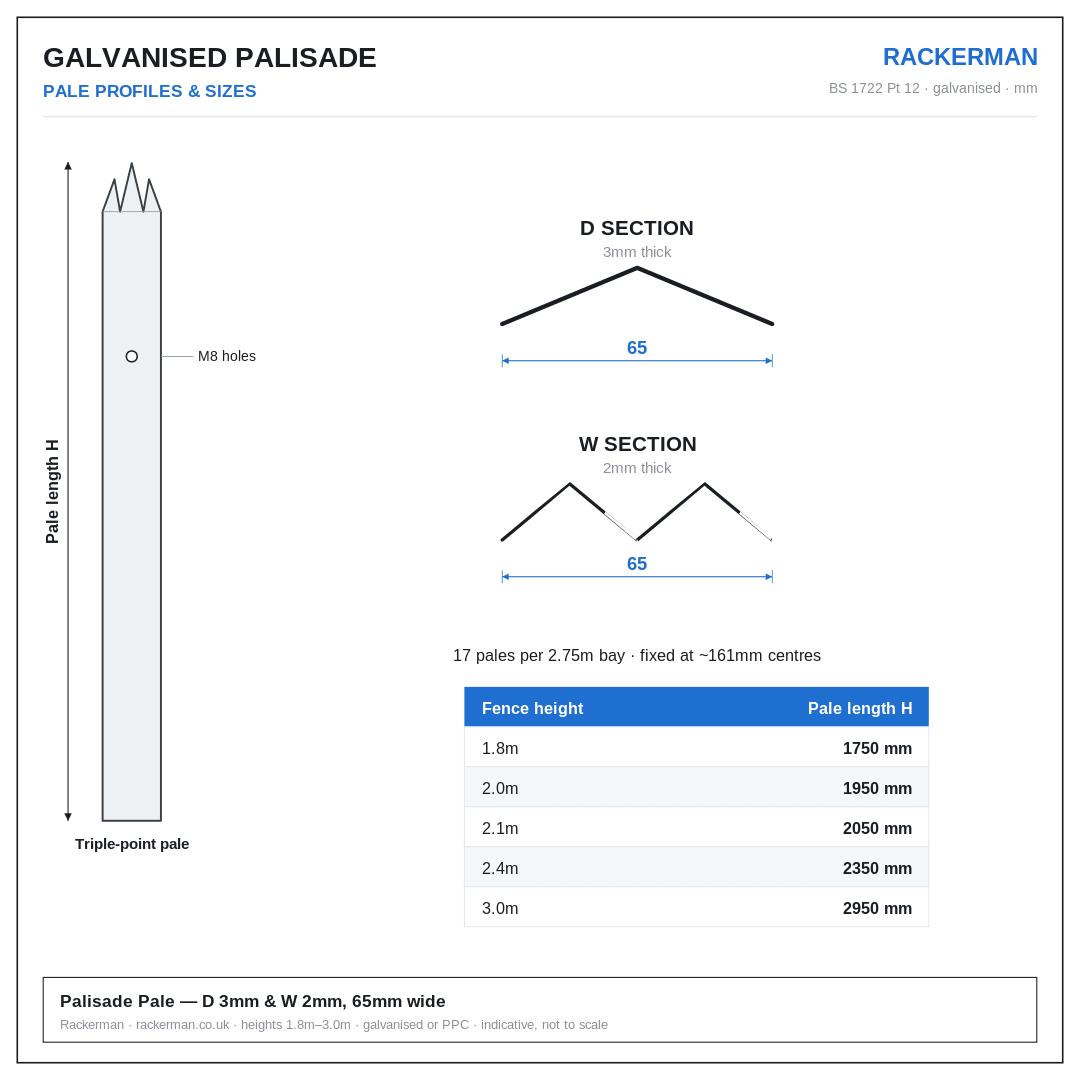
- Pales: 65mm wide, triple-point top — D 3.0mm (high security) or W 2.0mm (standard); 17 per bay at ~161mm centres
- Posts: steel RSJ from 98×55mm (heavier section on taller runs) — bolt-down with 200×200×10mm baseplate, or concrete-in
- Rails: 6mm angle by height — 40×40 (1.8m), 45×45 (2.0–2.4m), 50×50 (3.0m); 2 per bay
- Fixings: Anti-vandal pale & rail bolts included per bay
Technical drawings
Dimensioned PDFs for specification & installation — open in a new tab.
Palisade vs other security fencing
Where galvanised palisade sits against the main UK perimeter options. It’s routinely specified by insurers as a cost-effective security fence, with a roughly 25-year hot-dip galvanised life.
| Steel palisade | 358 “prison” mesh | Welded / twin-wire mesh | Chain link | Timber | |
|---|---|---|---|---|---|
| Security level | High | Very high (SR-rated) | Medium–high | Low | Low |
| Anti-climb | Spiked top, no footholds | Tiny apertures — no grip | Good | Poor — easily climbed | Poor |
| Cut resistance | High — heavy pales | Very high | Medium | Low | Low |
| Through-visibility | Partial | High | High | High | None (screening) |
| Appearance | Industrial, intimidating | Neat, professional | Clean, professional | Utilitarian | Natural |
| Lifespan | ~25+ yrs, hot-dip galv | Decades | Decades | 10–20 yrs | 10–15 yrs |
| Uneven ground | Good — rakes to slope | Harder (rigid panels) | Harder (panels) | Excellent | Good |
| Relative cost | ££ | ££££ | ££ (~40% less) | £ | £ |
| Best for | Industrial & commercial security | Prisons, airports, data centres | Schools, sports, public sites | Boundary & demarcation | Domestic screening |
In short: chain link and timber mark a boundary; welded/twin-wire mesh balances security with visibility for public-facing sites; 358 mesh is maximum security at a premium; palisade is the intimidating, hard-to-beat industrial standard at a mid-market price.
How it goes up
A straightforward four-step install — or ask us about a fitting service.
Mark the line at 2.75m centres. Concrete in the posts, or bolt baseplated posts to hardstanding.
Bolt the top & bottom rails between posts through the fish plates with the rail bolts.
Bolt each pale to both rails and torque the anti-vandal nuts so they can’t be undone.
Add the extra end post to close the run, then check the line and torque throughout.
Flat £15 UK delivery
Palisade is heavy galvanised steel and ships on a pallet — one flat £15 to UK mainland, typically within 5–10 working days.
One flat £15 delivery on any order — full run or a single part. Most suppliers charge £100–£300+ in carriage to the same postcodes.
Larger or heavier orders need offloading — please ensure suitable access and unloading on site.
Typical dispatch window. Highlands, islands and NI may carry a surcharge or need a quote.
Big project, or not sure what you need?
For runs over 50m, multiple heights, corners, gates or a full takeoff, send us your total length, height, pale profile and fixing method and we’ll come back with a project price.
Galvanised palisade fencing is the UK trade standard for industrial and commercial security perimeters, and this page carries the complete steel palisade fencing system in every height from 1.8m to 3.0m. Choose your height and component above and buy a full 2.75m run kit, or any single part — pales, posts, rails, fish plates or bolts — on its own. Galvanised throughout, competitively priced, and delivered UK-wide for a flat £15. New to palisade? See what is palisade fencing for heights, profiles and installation.
Palisade fencing calculator
Use our interactive palisade fencing calculator to design your run in 3D — enter each side length, choose your height, pale profile and fixing, and it works out every bay, post and fitting and adds them straight to your basket. It handles straight runs, corners and full perimeters, and gets the post count right: each 2.75m bay includes one post, plus one extra to finish the run.
Steel palisade fencing built to BS 1722 Part 12
Our galvanised steel palisade fencing is manufactured to BS 1722 Part 12, the UK standard for steel palisade security fencing, and hot-dip galvanised to BS EN ISO 1461 for long-term corrosion resistance. Posts are a 98 × 55mm RSJ (6.72 kg/m); horizontal rails are 6mm RSA angle that steps up with height — 40 × 40 up to 2.0m, 45 × 45 for 2.1–2.4m, and 50 × 50 at 3.0m. Each 2.75m run kit contains 17 pales (D or W profile), 2 rails, fish plates, 1 post and the pale and rail bolts — everything to build one 2.75m bay.
Palisade fencing specification & dimensions
| Specification | Detail |
|---|---|
| Standard | BS 1722 Part 12 (steel palisade security fencing) |
| Finish | Hot-dip galvanised to BS EN ISO 1461 |
| Heights available | 1.8m, 2.0m, 2.1m, 2.4m, 3.0m |
| Pale profiles | D section (3.0mm, triple-pointed) or W section (2.0mm) |
| Post section | 98 × 55mm RSJ (6.72 kg/m) |
| Horizontal rails | 6mm RSA angle, by height — 40×40 (1.8m), 45×45 (2.0–2.4m), 50×50 (3.0m); 2 rails per bay |
| Run / bay size | 2.75m bay = 17 pales, 2 rails, fish plates, 1 post, bolts |
| Fixings | M8 saddle bolts + shear nuts (pales); M12 cup-square bolts + shear nuts (rails) |
| Post fixing | Bolt-down (200×200×10mm baseplate; 220×220×10mm at 3.0m) or concrete-in |
For the full dimensioned bay detail and complete per-height dimensions — pale lengths, post lengths, dig-in depths and baseplates — see our palisade fencing specification & dimensions reference.
Every palisade fencing component on one page
Palisade fencing isn't sold by the metre — it's built from 2.75m run kits plus separate parts. This page lists every metal palisade fencing component: 2.75m run kits (bolt-down or concrete-in, D or W profile), single D and W pales, bolt-down posts with baseplate, concrete-in posts, horizontal rails, standard, end and corner fish plates, and packs of palisade fencing bolts. Order a full run for a new security fence, or a single pale, post or bolt pack for a repair or top-up.
Palisade vs other fencing
Palisade is the high-security industrial choice, but it isn't always the right fit. For public-facing sites or lower-risk boundaries where visibility matters, compare it with our welded mesh fencing and galvanised mesh panels, or our temporary Heras-style fencing for construction sites and events. Palisade wins on deterrence and cut-resistance; mesh wins on cost and sightlines. For a full run-down of the options, see our guide to the types of metal security fencing.
D profile vs W profile pales
D profile pales are 3.0mm thick with a triple-pointed top — heavier duty, harder to climb, the standard choice for high-security and commercial palisade fencing. W profile pales are 2.0mm thick with a notched top — lighter and lower cost for domestic and lower-risk boundaries.
Bolt-down vs concrete-in posts
Bolt-down palisade fencing posts have a welded baseplate (200×200×10mm, or 220×220×10mm at 3.0m) and fix to existing concrete or hardstanding with anchor bolts — fast to install. Concrete-in posts are plain-based and set into a fresh concrete footing — more secure and standard for new installations.
Palisade fencing heights: 1.8m to 3.0m
1.8m to 2.0m suits domestic and light commercial boundaries; 2.1m to 2.4m palisade fencing is the common commercial security height for depots, yards and car parks; 3.0m is specified for high-security sites such as substations, utilities and infrastructure. All five heights are galvanised and held in stock for UK delivery.
Palisade fencing prices
Palisade fencing prices on this page start from around £255 per 2.75m run kit for 1.8m in-concrete W profile, rising with height and with heavy-duty D profile. Because you buy exactly the runs and components you need, there's no minimum order and no installer mark-up: trade and DIY buyers pay the same competitive supplier price. For a full price breakdown by height, see our palisade fencing cost per metre guide. For large projects (typically 50m+, multiple heights, or layouts with corners and gates) contact us for a project quote.
UK delivery — flat £15, anywhere in mainland UK
As a direct palisade fencing supplier we deliver galvanised steel palisade nationwide for a flat £15 — whether it's a full 2.75m run or a single pale, post or bolt pack. Most palisade suppliers charge £100–£300+ in carriage to the same postcodes, so on a delivered-to-your-door basis we're hard to beat, especially to remote and rural sites. Orders are sent on a pallet, typically within 5–10 working days. Offload assistance is required for larger or heavier orders, so please make sure suitable access and unloading is available.